

National Character Area 70
Melbourne Parklands - Analysis: Ecosystem Services
Analysis supporting Statements of Environmental Opportunity
The following analysis section focuses on a selection of the key provisioning, regulating and cultural ecosystem goods and services for this NCA. These are underpinned by supporting services such as photosynthesis, nutrient cycling, soil formation and evapo-transpiration. Supporting services perform an essential role in ensuring the availability of all ecosystem services.
Bodiversity and geodiversity are crucial in supporting the full range of ecosystem services provided by this landscape. Wildlife and geologically-rich landscapes are also of cultural value and are included in this section of the analysis. This analysis shows the projected impact of Statements of Environmental Opportunity on the value of nominated ecosystem services within this landscape.
Further analysis on landscape attributes and opportunities for this NCA is contained in the Analysis: Landscape Attributes & Opportunities section.
Natural Capital
Further information on Natural Capital within this NCA is contained in the Natural Capital and Key Ecosystem Services section.
The Melbourne Parklands NCA provides a wide range of benefits to society. Each is derived from the attributes and processes (both natural and cultural features) within the area. These benefits are realised through the ‘ecosystem services’ that flow from the ‘ecosystem assets’ or ‘natural capital’ of a place.
Natural capital means ‘the elements of nature that directly or indirectly produce value to people, including ecosystems, species, freshwater, land, minerals, the air and oceans, as well as natural processes and functions’ (Natural Capital Committee, 2017).
Ecosystem Services Main Beneficiaries
The below map displays the main beneficiaries of each ecosystem service identified within this NCA and neighbouring NCAs. These range from being of international importance to local importance. Some services have not been assessed within all NCAs, and therefore in some NCAs are displayed as “N/A” (not applicable).
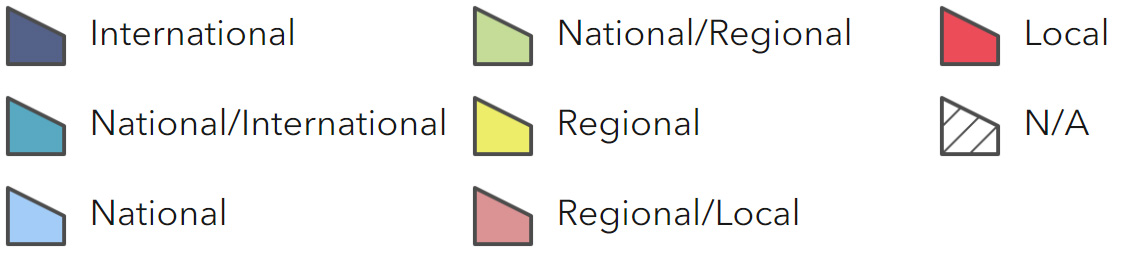
Main Beneficiaries Map
View Main Beneficiaries Map full screen in a new tab View Interactive Map HelpEcosystem service analysis
The following sections show the analysis used to determine key Ecosystem Service opportunities within the area. These opportunities have been combined with the analysis of landscape opportunities to create Statements of Environmental Opportunity. Please note that the following analysis is based upon available data and current understanding of ecosystem services. It does not represent a comprehensive local assessment. Quality and quantity of data for each service is variable locally and many of the services listed are not yet fully researched or understood. Therefore analysis and opportunities may change upon publication of further evidence and better understanding of the inter-relationship between services at a local level.
Note that numbers and figures in the body of the text are based on the 2014 profiles, unless otherwise stated.
Provisioning Services
Food provision
Assets/attributes: main contributors to service –
- Varying and versatile soil types with mixed farming
- Large open arable fields on the broader plateau
State – Extensive arable production on the broad plateau with small-scale pastures on heavier soils, steep slopes and around settlements.
Statistics from 2009 show that lowland grazing of livestock; 9,589 sheep, 7,032 cattle and 3,738 pigs.
In 2009, the predominant agricultural sectors were; cereal producers (representing 37 per cent of the farmed area) and lowland grazing units (37 per cent of the farmed area) with other mixed arable and combinable crops.
The Calke Estate retains a number of dairy farms.
Main beneficiary – Regional
Analysis – Food provision is important to the NCA and the various soil types support a diverse range of crops. Soils derived from Triassic Mercia mudstones produce moderately fertile reddish clay soils. The less permeable soils and lush vegetation associated with water courses lend themselves to pasture and historically, dairying.
The drier soils lend themselves better to potatoes and cereals with wheat, barley and maize the main arable crops on better soils. The very best dark loams of Melbourne are used for market gardening.
An increase in the number of Environmental Stewardship agreements has resulted in improvements to farmland habitats and a strengthening of landscape features. Special options to manage several parklands have been agreed with landowners resulting in one of the largest areas of arable reversion in the country at Calke Park.
Opportunities – A continued increase to the area of land under stewardship agreement can further strengthen and improve the quality of the landscape character and ecological richness of the NCA within the farmed environment.
Work in collaboration with farmers to maintain levels of productivity and maximise the benefits of varied and versatile soils, while investigating and applying management techniques that enhance landscape character and increase biodiversity.
Work in collaboration with riparian land owners and managers to manage watercourses to prevent diffuse pollution entering the water courses.
Principal services offered by opportunities –
- Food provision
- Biodiversity
- Regulating soil erosion
- Regulating soil quality
- Sense of place/inspiration
Timber provision
Assets/attributes: main contributors to service –
- Broadleaf woodland is a dominant feature of the landscape
- Fast growing willow and alder
- Soils
State – The existing woodland cover (1,499ha) represents 10 per cent of the area of the NCA.
In the valley bottoms, there are stands of fast growing willow and alder.
Extensive estate mixed woodlands and new woodland planting associated with The National Forest. The National Forest creates a strong woodland linkage to the neighbouring coalfield NCA and the Charnwood NCA.
Main beneficiary – Local
Analysis – Estate influences are evident with many of the woodlands being mixed species plantations managed for both traditional uses and for commercial timber.
Sustainable woodland management at a small-scale is being trialled at Calke
Park where the woodlands are providing fuel to a wood-fuel boiler that heats the visitor centre.
The National Forest has had a positive impact in other areas and this is born out in the Countryside Quality Counts data for the period 1999-2003 when woodland planting strengthened the landscape character.
Opportunities – Opportunities exist to manage the existing woodland more sustainably for commercial purposes, which will also have a beneficial effect upon other services.
New commercial plantations should continue to respect existing woodland patterns, the setting of historic houses and their associated parklands. New plantations strengthen the landscape character by linking together areas of woodland.
Work in collaboration with the Forestry Commission to further the objectives contained within the Strategy for The National Forest (The Strategy: The National Forest 2004-2014, The National Forest, 2004).
New plantation woodlands can provide shelter belts which could reduce incidences of soil erosion.
Principal services offered by opportunities –
- Timber provision
- Recreation
- Sense of history
- Sense of place/inspiration
- Regulating soil erosion
Water availability
Assets/attributes: main contributors to service –
- Two extensive reservoirs
- Small aquifer
- Soils
State – There are no main rivers in the NCA however; there are two extensive reservoirs, Foremark and Staunton Harold Reservoirs, both important for water supply as well as for their ecological, conservation and recreational value.
Sandstones of the Sherwood Sandstone Group outcrop in the NCA provide an important pathway for surface water to recharge the Sherwood aquifer.
Main beneficiary – Regional
Analysis – Erosion by rivers has produced a plateau that is deeply incised in places forming narrow valleys. Two valleys have been dammed to create reservoirs at Foremark and Staunton Harold. Both are important for water supply. Staunton Harold was constructed around one of six naturally occurring ponds. Foremark reservoir draws water from outside the NCA from the River Dove and supplies Melbourne water treatment works. In August 2010 water storage levels were 83 per cent at Foremark and 74 per cent at Staunton Harold.
Opportunities – Opportunities exist for careful management of water to avoid over-abstraction, through efficient use of water and seeking more sustainable sources of water supply where possible.
Seek opportunities to increase areas of semi-natural habitats, especially grassland, to improve water infiltration.
Work in collaboration with farmers to seek ways of increasing rates of infiltration on the arable plateau and reducing chemical inputs especially in aquifer recharge areas.
Seek to minimise incidences of compaction on clay soils, which can arise from over-grazing, trafficking or other mechanised activities. This leads to nutrient loss and worsening rates of water infiltration, a particular problem in the aquifer recharge areas.
Work in collaboration with riparian land owners and managers to manage watercourses to prevent diffuse pollution entering the water courses and allow water table levels to rise where appropriate.
Principal services offered by opportunities –
- Water availability
- Food provision
- Regulating soil quality
- Regulating soil erosion
- Biodiversity
- Recreation
Genetic diversity
Assets/attributes: main contributors to service –
- Deer herds
- Traditional orchards
State – Donington Park still contains a managed deer herd with a very long genetic continuity.
There is a long association with market gardening in the area and associated remnant orchards survive today containing local and traditional varieties such as the Newton Wonder.
Main beneficiary – Local
Analysis – Deer parks have a long association with parkland landscapes and are often based on earlier deer parks and in some cases retaining elements of the boundaries of the medieval pale.
Changes in land use and a lack of management of orchards have resulted in many being lost. The National Forest has objectives to establish new orchards and manage remnant ones, which may help to preserve the genetic characteristics contained within them.
Opportunities – Adaptive characteristics may exist in the deer herd that could be significant in pest and disease resistance and should be considered an asset to the NCA.
Adaptive characteristics may exist in local varieties of apples that could be significant in pest and disease resistance and should be considered an asset to the NCA.
Principal services offered by opportunities –
- Genetic diversity
- Biodiversity
- Sense of history
- Sense of place/inspiration
- Food provision
Biomass energy
Assets/attributes: main contributors to service –
- Existing woodland
- Soils
State – The existing woodland cover (1,499ha) represents 10 per cent of the area of the NCA.
Main beneficiary – Local
Analysis – Sustainable woodland management at a small scale is being trialled at Calke Park where the woodlands are providing fuel to a wood-fuel boiler that heats the visitor centre.
An undulating landform, well-treed character and sense of enclosure could provide opportunities for miscanthus and short rotation coppice provided that the integrity of archaeological remains, historic parklands and estates and viewpoints are not compromised.
Opportunities – Opportunities exist to identify other sites where wood/biomass boilers could be installed.
Opportunities exist for planting short rotation coppice and miscanthus on lowland slopes. This would also benefit the regulation ofwater flow, by reducingrates ofrun-off.
There could be a potential benefit to the sense of place and history in growing miscanthus thus restoring historic enclosures and would provide a more intricate landscape in the most intensive arable areas.
Plantations could also extend woodland edges.
Plantations should respect existing woodland patterns, the setting of historic houses and their associated parklands.
Principal services offered by opportunities –
- Biomass energy
- Biodiversity
- Climate regulation
- Regulating water flow
- Regulating soil erosion
- Sense of place/inspiration
- Timber provision
Regulating Services
Climate regulation
Assets/attributes: main contributors to service –
- High carbon content soils
- Woodland
- Permanent grassland
State – The soils over most of the NCA have a low carbon content (0-5 per cent) although there are small pockets of soil with a higher carbon content (5-10 per cent) associated with areas of certain woodlands and permanent grasslands.
Main beneficiary – Local
Analysis – The majority of the soils in the NCA offer limited potential to improve climate regulation. Woodland is likely to be the most significant contributor in this NCA.
Good management of existing woodland can ensure its role in sequestering and storing carbon is optimised. The expansion of woodland on suitable sites could increase carbon sequestration and storage. This expansion could also benefit other services.
Opportunities – 11 per cent of The National Forest is within the NCA. Local targets within the Landscape Action Plan for The National Forest could optimise the management of existing woodland and identify areas for planting while maintaining the existing planting patterns thus strengthening the character of the NCA and identifying key locations for long- term carbon storage in woodland soils.
Biodiversity, regulation of water flow through interception and sense of history could all benefit from the expansion of woodland. However, new plantations on agricultural land may limit increases in food production.
Opportunities exist around management and creation of permanent grassland, particularly in river valleys and the fringes of reservoirs. The creation of reedbeds which are a potentially good carbon store.
Principal services offered by opportunities –
- Climate regulation
- Biodiversity
- Regulating water flow
- Sense of history
- Regulating soil quality
Regulating coastal erosion and flooding
No information available.
Regulating water quality
Assets/attributes: main contributors to service –
- Reservoirs
- Sherwood Sandstone aquifer
- Soils
- Semi-natural grassland
State – For information regarding the current state of water quality within this NCA, refer to the Environment Agency (Draft river basin management plan maps).
Main beneficiary – Regional
Analysis – Staunton Harold Reservoir was created from one of six naturally occurring ponds in 1964 to provide Leicester and the East Midlands with drinking water. Controlling pollutants and sediments entering feeder watercourses as a result of soil and nutrient run-off and livestock directly accessing water courses, could improve the ecological quality of the water.
A widespread decline in dairying may have locally improved water quality by reducing the incidences of manures, slurry and silage effluent reaching the water courses.
Foremark Reservoir was created in the 1970s and is fed by the River Dove, which lies outside the NCA and supplies Melbourne water treatment plant.
Replenishment of the Sherwood Sandstone aquifer is desirable. Areas underlain by Triassic sandstone provide a potential pathway for surface water to recharge the aquifer.
The correct management of clay soils can play an important part in regulating water flow.
Opportunities – There exists an opportunity to encourage riparian landowners to take steps to reduce soil erosion and nutrient loss from farmland through best practice and management plans.
Encourage arable reversion and the establishment of permanent grassland, especially alongside water courses, with low input management, to reduce nutrient run-off and increase water infiltration.
Principal services offered by opportunities –
- Regulating water quality
- Regulating soil erosion
- Regulating soil quality
- Food provision
- Biodiversity
Regulating water flow
Assets/attributes: main contributors to service –
- Wooded river valleys
- Vegetated steep slopes
- Clay soils
State – There are no main rivers in the NCA although there are tributaries of the rivers Dove and Trent.
Main beneficiary – Local
Analysis – The Environment Agency’s Flood Risk Assessment indicates that for much of the NCA flooding is not generally a major issue, although there are some relatively small areas of ‘significant’ flood risk associated with tributaries and the floodplain associated with the River Trent that skirts the northern boundary of the NCA.
The correct management of clay soils can play an important part in regulating water flow.
Opportunities – There exists opportunities for flood risk management for example the identification of locations where flood attenuation ponds or wetland areas could be created with associated habitat improvement and the identification of potential sites for priority habitat creation (The River Trent Catchment Flood Management Plan Summary Document, Environment Agency, 2010).
It is important to minimise incidences of compaction on clay soils, which can arise from over-grazing, trafficking or other mechanised activities. This leads to nutrient loss and worsening rates of water infiltration, a particular problem in the aquifer recharge areas.
There is an opportunity to increase vegetation cover and extend areas of floodplain habitats such as flood meadows, wet woodland and reed beds. These could be considered to attenuate the flow downstream and increase rates of infiltration particularly in the aquifer recharge areas.
Principal services offered by opportunities –
- Regulating water flow
- Regulating water quality
- Biodiversity
- Water availability
Regulating soil quality
Assets/attributes: main contributors to service –
- Slowly permeable clay soils
- Lighter soils on the central plateau
- Higher quality soils around Melbourne
State – The slowly permeable clay soils can suffer from compaction and/or capping when wet, damaging the soil structure.
Main beneficiary – Local
Analysis – It is important to minimise incidences of compaction on clay soils, which can arise from over-grazing, trafficking or other mechanised activities. This leads to nutrient loss and worsening rates of water infiltration, a particular problem in the aquifer recharge areas.
Minimising incidences of flooding through regulation of water flow in water courses can have multiple benefits; reducing soil erosion maintaining soil structure and reducing the amount of leaching of nutrients.
Opportunities – There exists opportunities to implement management techniques, for example minimal tillage.
Increasing the percentage of organic matter in the soil improves the soil structure and can lead to reduced incidence of soil compaction.
Opportunities relating to the regulation of water quality and water flow also have a beneficial effect on soil quality and food production.
Principal services offered by opportunities –
- Regulating soil quality
- Regulating water flow
- Food production
- Biodiversity
Regulating soil erosion
Assets/attributes: main contributors to service –
- Reddish clay soils over the majority of the NCA
- Wooded valleys
- Uncultivated areas on steep valley slopes
- Cross field hedgerows
State – Soil erosion has not been identified as an issue for the majority of the NCA, although there is a risk of soil erosion on lighter soils in the far west of the area.
Main beneficiary – Local
Analysis – A decrease in the amount of land used for pastoral farming, an increase in the amount of land used for cereal production and loss of some hedgerows has increased the risk of soil erosion on lighter soils in the far west of the area.
Stability of soils under permanent pasture and woodland particularly on steeper sided valley slopes.
Minimising incidences of flooding through regulation of water flow in water courses can have multiple benefits; reducing soil erosion maintaining soil structure and reducing the amount of leaching of nutrients.
Opportunities – There exists opportunities to implement management techniques, for example minimal tillage, that reduce soil erosion and nutrient loss from farmland and improve livestock management through best practice and management plans.
The expansion of permanent grassland and semi-natural habitats on steep valley slopes can help to reduce soil loss, regulate surface water run-off and increase the rate of water infiltration.
Opportunities exist for the reinstatement of cross field hedgerows to reduce incidences of wind-blown soil erosion.
Principal services offered by opportunities –
- Regulating soil erosion
- Regulating soil quality
- Regulating water quality
- Regulating water flow
- Biodiversity
- Climate regulation
- Food production
Pollination
Assets/attributes: main contributors to service –
- Lowland heathlands
- Lowland meadows
- Remnant orchards
State – Some habitats in the NCA, such as lowland heathlands, remnant orchards in the north of the area and lowland meadows, support a variety of pollinators and nectar sources.
Main beneficiary – Local
Analysis – Pollination is not currently a service required by the predominant agricultural crop. However, an increase to this service could deliver multiple benefits.
Opportunities – An expansion to this service may facilitate the growing of a greater diversity of crops in the future thus improving resilience to food supply. An increase to this service is likely to improve biodiversity.
Principal services offered by opportunities –
- Pollination
- Biodiversity
- Food provision
Pest regulation
Assets/attributes: main contributors to service –
- Areas of semi-natural habitat
- Hedgerows
State – Areas of semi-natural grassland and hedgerows proximal to areas of agricultural production.
Main beneficiary – Local
Analysis – Semi-natural habitats and hedges proximal to areas of commercial agriculture may support species of predators, which can regulate populations of pests that adversely affect food and timber provision.
Opportunities – Opportunities exist to enhance semi-natural habitats and re- instate hedgerows through Countryside Stewardship. This would provide a mosaic of habitats in areas of monoculture, thus providing a more robust ecosystem.
Principal services offered by opportunities –
- Pest regulation
- Food provision
- Timber provision
- Biodiversity
Cultural Services
Sense of place/inspiration
Assets/attributes: main contributors to service –
- Historic parklands and country houses
- The National Forest
- Extensive estate mixed woodlands
- Undulating landform
- Many valleys with riverside meadows
- Estate farmlands on the plateau
- Red brick villages
- Reservoirs
- Sandstone slopes and heaths
- Prominent and imposing churches
State – Sense of place is invoked by the large landscaped parklands and grand country houses surrounded by extensive estate woodlands and the associated red brick estate farmsteads and villages set within an undulating, tranquil, mixed farming landscape.
This is supported by the undulating landform dissected by narrow river valleys, prominent in the wider landscape as they are fringed by a ribbon of willow and alder, with small woods sited on ridge tops.
The large reservoirs at Foremark and Staunton Harold and the imposing and dramatically-sited churches, for example at Melbourne and at Breedon-on-the-Hill, where the church overlooks cliffs created by quarrying.
Main beneficiary – Regional
Analysis – 11 per cent of the NCA lies within The National Forest. Collectively the trees and woodlands play an important role in emphasising estate character. Dense lines of trees along watercourses and locally prominent parkland and amenity trees play a key role in defining the scale and enclosure of the intervening spaces.
The woodlands are relatively well-linked with large blocks linked to the National Trust’s Calke estate and the nearby Staunton Harold estate.
Both reservoirs offer a range of leisure opportunities with popular visitor centres and children’s play areas.
The churches have developed a dual role as spiritual centres and historic buildings containing works of art. They also contribute to the wider landscape as landmarks, most notably the Priory church of St Mary and St Hardulph, Breedon-on- the-Hill.
Opportunities – Landscape action plans for the proportion of the NCA that lies within The National Forest identify: woodland planting in large blocks to reinforce the landscape character; increasing the extent of lowland acid grassland; neutral grassland and heath grassland for the benefits this will bring to landscape character and other provisioning services.
Planting and restoring hedgerows strengthens the landscape character but also benefits soil erosion and soil quality.
Habitat creation on riparian land can also benefit the regulation of water quality and water flow.
Opportunities exist throughout the NCA to compliment these plans through appropriate Countryside Stewardship agreements and initiatives associated with the Water Framework Directive that will benefit biodiversity.
Principal services offered by opportunities –
- Sense of place/inspiration
- Recreation
- Sense of history
- Regulating water quality
- Regulating water flow
Sense of history
Assets/attributes: main contributors to service –
- Ecclesiastical centres
- Historic country houses
- Designed parklands
- Prominent and imposing churches
- Viking sites
- Anglo-Saxon settlement pattern
- Areas of ridge and furrow
State – A sense of history is invoked by the area’s imposing and historically-important country houses and designed parklands. There are s7registered parks and gardens representing 4 per cent of the area.
There are 14 Scheduled Monuments and 537 listed buildings.
Prominently sited churches as well as the traditional built vernacular.
Many of the historically important sites visible today overlay earlier settlements.
Main beneficiary – Regional
Analysis – The NCA has a strong Christian heritage with many of the estates and grand houses for example, Calke and Melbourne, which date from the 17th and 18th centuries, originally being monasteries. Repton and Breedon-on- the-Hill were major ecclesiastical centres of the kingdom of Mercia.
Repton was the seat of the Bishop of Mercia and the 8th and 9th century Anglo-Saxon stone carvings at Breedon church are amongst the finest of their type.
During the second half of the 9th century, Vikings landed at Repton and incorporated the abbey into their fortifications. They chose Ingelby, nearby, as their burial site and it is the only known Scandinavian cremation cemetery in England.
Prominently sited churches for example at Breedon and fine examples of Norman architecture such as Melbourne Church, which is one of the most imposing and most complete Norman churches in England.
The principal material of the older buildings in the villages is brick with pan tile roofs although timber framing still exists in a few places. Churches have been constructed from friable sandstone and have been restored in 19th century restorations.
Some field patterns reflect early enclosures and there are areas of surviving ridge and furrow indicative of historic land use. Soil is also important in protecting buried archaeological features.
Many of the buildings are at risk from erosion and the settlement patterns of villages could be threatened by inappropriate development.
Below ground archaeology and areas of ridge and furrow could be at risk if there is an expansion to commercial agriculture.
Opportunities – Opportunities exist to protect, manage and interpret the many historic assets as stated in the Leicestershire, and Rutland Historic Landscape Characterisation Programme.
Restoration of hedgerows, arable reversion; expansion to, and maintenance of, woodland could restore enclosure patterns and historic land uses, reinforcing the sense of history of the NCA.
Opportunities exist to ensure that restoration of historic buildings and new developments use local building stone to maintain the vernacular and reflect the historic patterns of settlement.
Principal services offered by opportunities –
- Sense of history
- Sense of place/inspiration
- Recreation
Tranquility
Assets/attributes: main contributors to service –
- Historic parkland estates and woodlands
- Reservoirs
- Secluded valleys
State – Just 16 per cent of the NCA is classified as undisturbed according to CPRE data, a decline from around 40 per cent in the 1960s.
Main beneficiary – Local
Analysis – Tranquillity is associated with the large parklands and surrounding woodlands, as well as the unimproved pastures and heathy scrub on steep, undulating sandstone slopes and the areas around the reservoirs at Foremark and Stuanton Harold.
This disturbance largely relates to the high traffic volumes on the main roads that cross this small NCA including the A42, M1 and East Midlands Airport. Nevertheless this is largely a quiet, rural area.
Opportunities – Opportunities exist to retain the areas of tranquillity by protecting them from inappropriate development and by buffering developments by tree planting.
Principal services offered by opportunities –
- Tranquillity
- Sense of place/inspiration
Recreation
Assets/attributes: main contributors to service –
- Woodlands including The National Forest
- Reservoirs
- Secluded valleys
- A network of rights of way
- Green infrastructure
- Historic parkland estates
- National Cycle Network
State – Recreational opportunities are provided by the woodlands that form part of The National Forest.
Staunton Harold and Foremark reservoirs are popular with visitors seeking a range of outdoor recreation pursuits such as sailing, fishing, walking, pony-trekking and cycling. Both have popular visitor centres and children’s play areas.
Calke Abbey Estate including Calke Park SSSI and National Nature Reserve.
244 km of rights of way (at a density of 1.62 km per km2), and around 8 ha of open access land (covering 0.05 per cent of the NCA).
National Cycle Network route 6 passes through the NCA.
Main beneficiary – Regional
Analysis – The number of visitors to the NCA is important to the local economy. Visitor numbers to the National Trust estate at Calke Abbey in 2010 were approximately 250,000. The visitor centres at Staunton Harold and Foremark are important for environmental education provision.
Incorporation of green infrastructure into new developments can provide multiple benefits to other services.
National Cycle Network route 6 passes approximately north to south through the NCA linking Derby to Loughborough.
Opportunities – There is an ongoing initiative in The National Forest to create a large- scale forest that blends commercial forestry and non-commercial woodland creation with ecological, landscape and public access benefits, as well as maintaining the historic parkland landscapes.
Green Infrastructure offers the local community opportunities to enjoy their local greenspace and to take action to improve it as well as provide benefits to urban drainage and biodiversity.
Opportunities exist to promote the recreational and educational opportunities afforded by the network of rights of way and improved access to the open countryside from towns, which could have a beneficial effect on people’s health and well-being.
Opportunities exist to expand the local cycle network to link with the National Cycle Network route 6.
This would provide more accessible opportunities for physical exercise and contribute to solutions to sustainable transport.
Principal services offered by opportunities –
- Recreation
- Sense of place/inspiration
- Sense of history
Biodiversity
No information available.
Geodiversity
No information available.