

National Character Area 97
Arden - Analysis: Ecosystem Services
Analysis supporting Statements of Environmental Opportunity
The following analysis section focuses on a selection of the key provisioning, regulating and cultural ecosystem goods and services for this NCA. These are underpinned by supporting services such as photosynthesis, nutrient cycling, soil formation and evapo-transpiration. Supporting services perform an essential role in ensuring the availability of all ecosystem services.
Bodiversity and geodiversity are crucial in supporting the full range of ecosystem services provided by this landscape. Wildlife and geologically-rich landscapes are also of cultural value and are included in this section of the analysis. This analysis shows the projected impact of Statements of Environmental Opportunity on the value of nominated ecosystem services within this landscape.
Further analysis on landscape attributes and opportunities for this NCA is contained in the Analysis: Landscape Attributes & Opportunities section.
Natural Capital
Further information on Natural Capital within this NCA is contained in the Natural Capital and Key Ecosystem Services section.
The Arden NCA provides a wide range of benefits to society. Each are derived from the attributes and processes (both natural and cultural features) within the area. These benefits are realised through the ‘ecosystem services’ that flow from the ‘ecosystem assets’ or ‘natural capital’ of a place.
Natural capital means ‘the elements of nature that directly or indirectly produce value to people, including ecosystems, species, freshwater, land, minerals, the air and oceans, as well as natural processes and functions’ (Natural Capital Committee, 2017).
Ecosystem Services Main Beneficiaries
The below map displays the main beneficiaries of each ecosystem service identified within this NCA and neighbouring NCAs. These range from being of international importance to local importance. Some services have not been assessed within all NCAs, and therefore in some NCAs are displayed as “N/A” (not applicable).
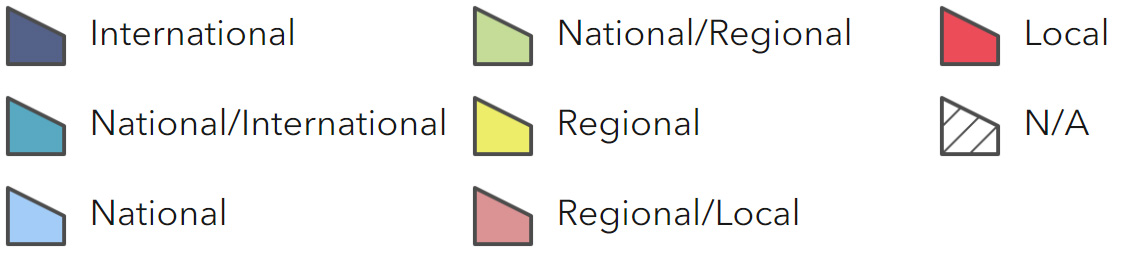
Main Beneficiaries Map
View Main Beneficiaries Map full screen in a new tab View Interactive Map HelpEcosystem service analysis
The following sections show the analysis used to determine key Ecosystem Service opportunities within the area. These opportunities have been combined with the analysis of landscape opportunities to create Statements of Environmental Opportunity. Please note that the following analysis is based upon available data and current understanding of ecosystem services. It does not represent a comprehensive local assessment. Quality and quantity of data for each service is variable locally and many of the services listed are not yet fully researched or understood. Therefore analysis and opportunities may change upon publication of further evidence and better understanding of the inter-relationship between services at a local level.
Note that numbers and figures in the body of the text are based on the 2014 profiles, unless otherwise stated.
Provisioning Services
Food provision
Assets/attributes: main contributors to service –
- Soils
- Livestock
- Mixed and cereal farms
State – Light, sandy soils predominate in the north with heavier clay soils and loams occurring extensively in central and southern Arden the majority of the soil is grade 3. In 2009, over 30 per cent of Arden’s holdings were lowland grazing livestock. Farms classified as ‘other’ (which will include smallholdings) 27 per cent; cereal farms 20 per cent; mixed farms 6.9 per cent. The area produces dairy and arable food crops alongside vegetables, pork, poultry, eggs but not on a large scale.
Main beneficiary – Local
Analysis – Expansion of food provision within the NCA could lead to increased production but could lead to less biodiversity and pollination sources, increase pressure on water availability (required for irrigation). It may also possibly have a huge impact on the character/sense of place of the landscape with uncultivated land being put into production.
Opportunities – There is scope to increase food provision but balance needs to be struck to ensure biodiversity/ water availability and other services do not suffer negative impacts.
Principal services offered by opportunities –
- Food provision
Timber provision
Assets/attributes: main contributors to service –
- Small woodlands
- Mature timber
- Ancient woodlands
State – Provision is currently low but it could be increased if new sites are planted or existing sites come into management. This would also increase climate regulation through carbon sequestration and local heating effects. It could provide increased opportunities for biodiversity and recreation if planted in appropriate locations. Woodland is a very strong key feature of Arden and new planting would enhance this sense of place.
Main beneficiary – The NCA contains 11,876 ha of woodland (8 per cent of the total area). 3 per cent of that resource is ancient woodland.
Analysis – Local
Opportunities – Opportunity to manage the many under-managed broadleaved woodlands in this NCA to provide timber and to encourage new woodlands in appropriate areas to provide biodiversity connectivity and increase recreation provision.
Principal services offered by opportunities –
- Timber provision
- Biodiversity
- Recreation
- Climate regulation
- Sense of place/inspiration
- Sense of history
Water availability
Assets/attributes: main contributors to service –
- Reservoirs, aquifers and rivers
State – The major metropolitan areas of Birmingham, Coventry and Redditch places considerable pressure on water resources. The Bartley, Frankley and Bittel reservoirs in south-west Birmingham provide drinking water for Birmingham. The major sandstone aquifers underlying the south of the NCA are the Triassic Sandstone Aquifer, over-abstracted and the Avon Confirmed Aquifer, which is over licensed and no water available for abstraction.
Main beneficiary – Regional
Analysis – Increasing water availability (through greater capture/infiltration) and further management of abstraction is likely to increase wetland biodiversity and improve quality. Greater water availability could also increase agricultural outputs at times when water for irrigation is limited, for example, during droughts.
Opportunities – There is an opportunity to manage water within the NCA to slow runoff to increase infiltration to the aquifer. There is also an opportunity to manage over- abstraction from the aquifer and rivers through careful and efficient use of water and through use of alternative more sustainable sources of water supply where possible.
Principal services offered by opportunities –
- Water availability
- Biodiversity
- Regulating water quality
- Food provision
Genetic diversity
No information available.
Biomass energy
Assets/attributes: main contributors to service –
- Small woodlands
- Existing woodland cover (8 per cent of NCA)
State – There is currently limited potential for the provision of biomass through bringing unmanaged woodland under management. There is generally a high potential yield for miscanthus, and a medium or high potential yield for short rotation coppice (SRC) in the NCA. For information on the potential landscape impacts of biomass plantings within the NCA, refer to the tables on the Natural England website.
Main beneficiary – Local
Analysis – Biomass potential is currently low. However the area has medium or high potential for SRC. Increased provision of SRC for fuel has the potential to increase climate regulation, but could decrease provision of future food if placed on farmed areas or on biodiversity if placed on areas of non-agricultural production. Major expansion could also affect sense of place.
Opportunities – There is an opportunity to increase production of biomass through introducing management in currently unmanaged woodlands. There is also an opportunity for small-scale biomass production through planting on sites including, for example, small parcels of land isolated by development and closed quarry or mining sites.
There is also an opportunity to plant new broadleaf woodland or short rotation coppice where extension
or introduction of woodland character would be desirable, avoiding other priority habitats and historical features.
Principal services offered by opportunities –
- Biomass energy
- Climate regulation
- Biodiversity
Regulating Services
Climate regulation
Assets/attributes: main contributors to service –
- Woodlands
- Grazing marsh
- Grassland
- Fen
- Reedbeds
- Heathland
State – The majority of the NCA has a low soil carbon content of 0-5 per cent. However, around Birmingham, carbon content increases to 5-10 per cent.5 Carbon content is likely to be higher under the more than 11,876 ha of woodland within the NCA, as well as under the more than 1,000 ha of grazing marsh, grassland, fen, reedbeds, and heathland ( Special Areas of Conservation, Ensor’s Pool, Joint Nature Conservation Committe, 2010).
Main beneficiary – Regional
Analysis – Carbon storage in the areas of woodland, grazing marsh, grassland, fen, reedbeds and heathland
is likely to be higher, and this may be increased by the expansion of these areas. This may lead to a reduction in provisioning of food if planted on agricultural land. However, if created, there is good potential to increase biodiversity and increase recreational resource if publicly accessible. Creation may also increase the sense of place by enhancing the character of Arden.
Opportunities – There is an opportunity to increase the carbon storage potential of the area through the net expansion of new woodland, grazing marsh, grassland, fen, reedbeds and heathland in appropriate areas.
Principal services offered by opportunities –
- Climate regulation
- Biodiversity
- Recreation
- Sense of place/inspiration
- Regulating water
quality
Regulating coastal erosion and flooding
No information available.
Regulating water quality
Assets/attributes: main contributors to service –
- Woodlands
- Wetland habitat/reedbed
State – For information regarding the current state of water quality within this NCA, refer to the Environment Agency (Draft river basin management plan maps).
Main beneficiary – Regional
Analysis – Around Birmingham and Coventry groundwater chemical status is ‘poor’ so improvements are required to the water quality through selective reduction in inputs from point source pollution and diffuse pollution from for example, agricultural activities, through better land management and the buffering water courses, which should help address specific pollutant issues in water bodies in the north around the conurbations that fail standards.
Opportunities – Expansion of semi-natural wetland habitats adjacent to watercourses, including reedbeds and grazing marsh, plus creation of grassland buffer strips/restoration of hedgerows across slopes within river catchments.
Principal services offered by opportunities –
- Regulating water quality
- Regulating soil erosion
- Biodiversity
Regulating water flow
Assets/attributes: main contributors to service –
- Rivers
State – Tamworth is at medium risk of flooding from the rivers Tame and Anker and Bourne Brook. In Birmingham the key source of flooding is from the River Tame and its main tributary the River Rea, and the risk of flooding is high. There is a relatively high level of flood risk in Coventry from the River Sowe and the River Sherbourne. There are approximately 2,200 properties at risk of fluvial flooding within Warwick from the River Avon and in Redditch there are between 250 and 500 homes at risk of flooding from the River Arrow (River Severn Catchment Flood Management Plan, Summary Report, Environment Agency, 2009).
Main beneficiary – Local
Analysis – Within the NCA flooding may be reduced through well designed natural flood alleviation schemes such as river restoration and creation of new wetlands to retain water in situ. River corridors will benefit from further wetland habitat creation, the reduction of intensive land uses and re-establishing the natural processes associated with watercourses, including naturally-functioning floodplains. This should also go hand-in-hand with improved public access, where appropriate.
Opportunities – Creation and extension of semi- natural floodplain habitats such as flood meadows, wet woodland and reedbed riparian margins, thick hedges in floodplain, which dissect the direction of peak flow.
In particular, the existing wet meadows alongside the Blythe and Anker are areas where the river and its floodplain can function naturally, which in turn will help to reduce flood risk.
Principal services offered by opportunities –
- Regulating water flow
- Biodiversity
- Water availability
- Recreation
- Regulating soil erosion
- Regulating soil quality
Regulating soil quality
Assets/attributes: main contributors to service –
- Soils
- Heathland
- Woodlands
- Hedgerows
State – This NCA has 7 main soilscape types:
- Slowly permeable seasonally wet slightly acid but base-rich loamy and clayey soils, covering 36 per cent of the NCA.
- Slightly acid loamy and clayey soils with impeded drainage (26 per cent).
- Freely draining slightly acid loamy soils (13 per cent).
- Slowly permeable seasonally wet acid loamy and clayey soils (11 per cent).
- Loamy soils with naturally high groundwater (9 per cent).
- Loamy and clayey floodplain soils with naturally high groundwater (3 per cent).
- Freely draining slightly acid sandy soils (1 per cent).
The slowly permeable, seasonally wet, slightly acid but base-rich loamy and clayey soils (36 per cent) and the slowly permeable, seasonally wet acid loamy and clayey soils (11 per cent) may suffer compaction and/ or capping as they are easily damaged when wet. In turn this may lead to increasingly poor water infiltration and diffuse pollution as a result of surface water run-off.
Management measures that increase organic matter levels can help reduce these problems. Equally, the slightly acid loamy and clayey soils with impeded drainage (26 per cent) are easily poached by livestock and compacted by machinery when the soil is wet. Weak topsoil structures can easily be damaged. Careful timing of activities is required to reduce the likelihood of soil compaction.
The freely draining slightly acid loamy soils (13 per cent) may be valuable in enabling the recharge of the aquifers that underlie this NCA, requiring the maintenance of good soil structure, improved by the addition of organic matter, to aid water infiltration and requiring the matching of nutrients to needs to prevent groundwater pollution.
Main beneficiary – Local
Analysis – It is important to minimise compaction and/or capping risk on clayey soils, which can arise from over-grazing, trafficking or other mechanised activities. These will tend to exacerbate run-off problems as well as damaging soil structure. These soils may have limited potential for increasing organic matter levels by management interventions. This in turn should have enhanced benefits for biodiversity.
Opportunities – There is scope to employ minimal tillage and incorporate organic matter to increase levels of soil organic matter and relieve soil compaction
Principal services offered by opportunities –
- Regulating soil quality
- Regulating soil erosion
- Biodiversity
- Water availability
Regulating soil erosion
Assets/attributes: main contributors to service –
- Soils
- Woodlands
- Hedgerows
State – Nearly 60 per cent of the NCA is not generally susceptible to soil erosion (associated with the slowly permeable clayey soils, loamy soils with naturally high groundwater, and the floodplain soils with naturally high groundwater).
Of the remaining soils the slightly acid loamy and clayey soils with impeded drainage (covering 26 per cent of the NCA) are prone to compaction, capping/slaking, leading to increased risk of soil erosion by surface water run-off, especially on steeper slopes. By comparison, the light freely draining slightly acid loamy soils and the freely draining slightly acid sandy soils (together covering 14 per cent of the NCA) have enhanced risk of soil erosion on moderately or steeply sloping land where cultivated or bare soil is exposed. This is exacerbated where organic matter levels are low after continuous arable cultivation or where soils are compacted. There is the potential for wind erosion on some coarse textured cultivated variants.
Main beneficiary – Local
Analysis – Not a major issue for this NCA with over 60 per cent of the area not susceptible to soil erosion. Addressing the issue of soil erosion would require taking small areas of land out of production in high risk areas to reduce compaction, trap sediment and improve soil health. This approach would lower food production very slightly in the short term but could offer benefits to biodiversity by reducing sedimentation in rivers. It may also help store limited amounts of carbon and could help maintain fertility in the longer term. Strengthening the hedgerow network would add to the sense of place as well as increasing biodiversity.
Opportunities – There is scope to reinstate and strengthen hedgerows and create grass buffer strips across steeper slopes under arable cultivation. Also to strengthen the hedgerow network and increase the population of hedgerow trees in the river valleys.
Principal services offered by opportunities –
- Regulating soil erosion
- Biodiversity
- Sense of place/inspiration
- Regulating soil quality
Pollination
Assets/attributes: main contributors to service –
- Grassland meadows
- Heathland
- Gardens and parks
State – Grassland, meadows and heathland, totalling less than 1 per cent of the NCA area, provide limited nectar sources for pollinating insects although lengths of hedgerow and the numerous gardens and parks of the major built up areas of the NCA are likely to provide important nectar sources.
Main beneficiary – Local
Analysis – Increasing nectar sources, through creating and enhancing grassland, meadows, heathland and hedgerows may reduce the little food production that there is in the area, although, it would lead to a much needed increase in biodiversity.
Opportunities – Increase unimproved grassland, floodplain grazing marsh and woodland with a diverse ground flora, and plant and manage flowering hedgerows and nectar and forage mix areas (particularly in arable areas), to increase the diversity of flowering plants and increase the sustainability of local agricultural production.
Principal services offered by opportunities –
- Pollination
- Biodiversity
- Sense of place/inspiration
Pest regulation
No information available.
Cultural Services
Sense of place/inspiration
Assets/attributes: main contributors to service –
- Woodland cover
- Hedgerows and hedgerow oaks
- Wood pasture
- Landforms such as low rounded hills, steep scarps and incised valleys
- Lane network linking scattered farms and hamlets
- Former coalfields and colliery settlements
- Parklands, canals and railways
State – Countryside Quality Counts data suggests that the character of the resource has probably been maintained or is strengthening slowly. However there has been a general lack of woodland management in many places. Loss and deterioration of hedges and hedgerow trees, the former particularly as a result of field amalgamation. Many hedgerows have fallen into disrepair through a lack of and/or poor management. Hedgerow trees numbers have declined.
Main beneficiary – Regional
Analysis – Management to enforce sense of place is likely to increase sense of history. Conserving and enhancing the distinctive landscape features is also likely to benefit biodiversity by enhancing or expanding available habitat.
Opportunities – There is an opportunity to maintain a sense of place, valued by local people and visitors by conserving the variety of landscape features which give the NCA its distinctive character.
There are opportunities to maintain the historic features that provide local distinctiveness within the different parts of the NCA such as the industrial coal mining heritage.
There are opportunities to market the associations with Shakespeare’s ‘Forest of Arden’ and ensure the landscape features associated with that are conserved and enhanced.
Principal services offered by opportunities –
- Sense of place/inspiration
- Biodiversity
- Recreation
- Sense of history
Sense of history
Assets/attributes: main contributors to service –
- Wood pasture
- Deer parks
- Ancient oak woodland
- Historic field pattern
- Mining and built heritage
State – 1.7 per cent of NCA registered parks and gardens. 155 Scheduled monuments. 4,932 listed buildings. These contribute to a heritage of past coal mining and associated colliery villages as well as municipal and commercial buildings in Birmingham.
Main beneficiary – Local
Analysis – Increasing sense of history has some potential to increase tourism. This could in turn lead to increasing recreational opportunities and sense of place by reinforcing the historic character of the landscape.
Opportunities – There is an opportunity to increase sense of history by protecting the character and historic resource of the large country houses and parklands. Also by increasing the protection and appropriate management of above and below ground archaeology, ancient trackways and the established vernacular of settlements.
Principal services offered by opportunities –
- Sense of history
- Recreation
- Sense of place/inspiration
Tranquility
Assets/attributes: main contributors to service –
- Wooded landscape
- Sunken lanes
- Lack of visual and noise intrusion
State – Just 10 per cent of the NCA is classified as ‘undisturbed’ according to the CPRE Intrusion Map 2007, a decline from 34 per cent in the 1960s.
Main beneficiary – Local
Analysis – Increasing tranquillity through expanding areas of woodland could also increase biodiversity and sense of place.
Opportunities – There is an opportunity to protect tranquillity in some core areas where intrusion is currently low such as in the sunken lanes with hedgerows. This will increase the opportunity for people to feel connected to nature and contribute to wellbeing and health.
There is an opportunity to reduce where possible the impact of settlement and road infrastructure in the urban fringe areas by planting woodland shelter belts, strengthening the hedgerow pattern and ensuring new development on settlement fringes is sensitively designed.
Principal services offered by opportunities –
- Tranquillity
- Sense of history
Recreation
Assets/attributes: main contributors to service –
- Parklands
- Woodlands
- Formal parks
- Canals and rivers
- Wildlife reserves
- Reservoirs
State – Recreation is supported by 1,929 km of rights of way (at a density of 1.35 km per km2), and just 238 ha of open access land (covering 0.2 per cent of the NCA). Numerous parks provide recreational opportunities within and surrounding Birmingham, such as Edgbaston Park adjacent to the university, while the reservoirs to the south-west of the city are well used for sailing, fishing and bird-watching. Parks, canals and rivers feature throughout the NCA and provide varying levels of recreational opportunity, while numerous golf courses are prevalent features offering more prescribed recreation.
Main beneficiary – Local
Analysis – There is a strong resource here that could be utilised and increased without significant effects on other services. However, increased recreation may have minor negative effects on tranquillity, biodiversity through disturbance and potentially a small effect on food production through, for example, taking land out of production to produce paths in some areas
Opportunities – Maintain and enhance the access throughout the area on public rights of way, on the long- distance route Heart of England Way, on canal towpaths and cycle and recreational sites.
Open spaces should also be incorporated into well designed urban developments to provide recreational opportunities and potentially increase.
Principal services offered by opportunities –
- Recreation
- Sense of place/inspiration
Biodiversity
Assets/attributes: main contributors to service –
- Priority habitats including species-rich grasslands, heathlands, wetlands and woodlands
- Reservoirs
- Canal network
- Ensors Pool
State – Internationally designated site in the NCA – Ensor’s Pool SAC (4 ha) in Nuneaton, designated for supporting a very large population of white-clawed crayfish (Special Areas of Conservation, Ensor’s Pool, Joint Nature Conservation Committee Website, 2010). There are 56 SSSI, totalling less than 1 per cent of the NCA area. The majority of these (87 per cent) are in favourable or recovering condition; 12 per cent are in unfavourable condition.
Main beneficiary – Regional
Analysis – The improvement in the condition, and expansion, of woodland and priority habitats will assist in climate regulation through the storage of carbon. Increases in habitat extent could also have a positive effect on increasing recreation, water quantity, water quality and regulating soil erosion but is likely to have a negative impact on agriculture.
Opportunities – There is an opportunity to integrate woodland management and potentially extend broadleaved woodland, where appropriate, for biodiversity with timber and biomass production.
There is also an opportunity to protect, manage and extend the habitats within greenbelt and urban fringe to retain and increase biodiversity value and improve network connections. Opportunity to expand semi- natural wetland habitats adjacent to watercourses, including reedbeds and grazing marsh and manage and extend hedgerows.
Principal services offered by opportunities –
- Biodiversity
- Recreation
- Water availability
- Regulating water quality
- Regulation soil erosion
- Climate regulation
Geodiversity
Assets/attributes: main contributors to service –
- Exposed rock formations
- Designated geodiversity sites
State – There are 16 nationally designated geological sites within the NCA and 68 local sites. Many of the nationally designated sites are quarries or gravel pits.
Main beneficiary – National
Analysis – Designated sites provide important and accessible sections of geology allowing the interpretation, understanding and continued research into the geodiversity of the NCA.
Opportunities – Promote the geodiversity of the NCA particularly for recreational and educational use, adding to the sense of place and sense of history. There is an opportunity to manage some of the geological sites to enhance biodiversity.
Principal services offered by opportunities –
- Geodiversity
- Sense of place/inspiration
- Sense of history
- Biodiversity